Exhibition: All animals are equal, but some animals are more equal than others
Artist: Roger Muñoz
Curatorship: Roselin Rodríguez Espinosa
Acknowledgments: General Expenses
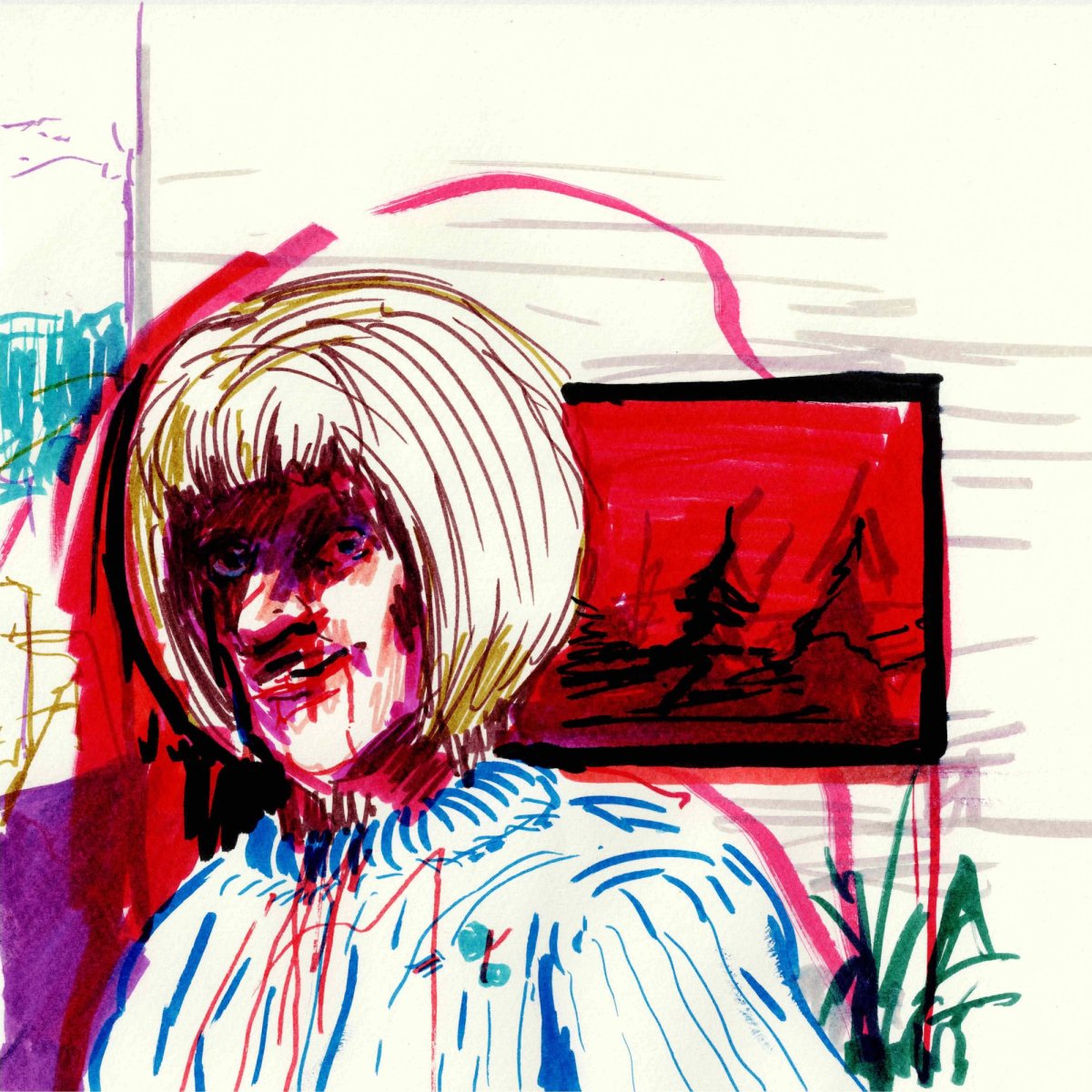
The same haircut kept appearing in the most and the least expected places. In all of them. I would look one way, and there it was on the head of the collector, and on that of the director of the famous foundation with the sinister gaze. Looking the other way, the director of the contemporary art museum did not escape it either, much less the director of the modern art one. The lady of every party, determined to look elegant behind her decadence, wore exactly the same haircut too. In her case, some dazzling ring and that short, bleached, thin, straight hair held together a body barely left standing. The same look made more than one of them gleam in their contempt for half the world. Later, at some dinner in the north of the city, more than three had been cut with the same scissors. It was clear that the bob had taken over the scenes where power was plotted. The star system of political history backs up this delirious paranoia: Margaret Thatcher, Angela Merkel, Hillary Clinton, Ursula von der Leyen and Callista Gingrich have shared the same style as part of their performance as women who can dominate everything. Their image has become synonymous with supremacy and imperial control, wars and social inequality. A sign of authoritarianism that Lic. Sniffany —Roger Muñoz’s travesti alter ego—, in her documentary fiction video made in collaboration with Mini, has called “a ridiculous kind of respectability that somehow survived,” an “almost mechanical respectability.” In the same film, produced by Horror TV, the artists share their detective investigation into this hairdo and state that “the bob ceased to be a hairstyle and became an instrument of control,” to explain how it has become a technology of authority.
For Roger Muñoz, the bob became a nightmarish fascination, a worthy trophy of seduction and study within the “drag horror” that much of his work has been developing in recent years. In his studio, depictions of this haircut resurface among drawings, watercolors, paintings and sculptures, alongside other objects that have emerged from his imagination, such as a mummified palm tree or a tomb of tlacoyos. Taken together, his work in tandem with the Licenciada —she who says and does what he does not dare to— contributes to the visual world of a tropical gothic with a long tradition in Latin America, bound up with anticolonial, antiracist and anticapitalist critique. In his case, this sunstruck gothic is made of a corrosive humor in drag and a decisive plot of class horror, where the seemingly banal details of our pop life reveal the gears of the oppressive power structures we inhabit.
The exhibition consists of a selection of drawings that gathers references from various projects of recent years, in which short, mostly blond hair associated with figures of female authority is approached as a surface implicated in one and the same economy of the cut and of domination. It is accompanied by a video by the artist in which the Lic. and her comadre Mini share their research on these subjects. Here it is revealed that the obsession with this haircut is inseparable from the fact that the Lic.’s own favorite wig is one in this style. On another occasion, she told its story: “The blond bob wig, acquired in 2019 during my process at SOMA to build Dúnia (El llanto del orín [The Weeping of Urine]), began as a simple tool of representation. At the time I still naively believed that objects served something as basic as ‘functioning.’ But that wig started to disobey: it stopped being a prop and began to move on its own within the work, changing roles without permission and accumulating meaning as if it had a consciousness of its own. Since then, it has gone through everything a decent object should avoid: it has been image, fragment, nuisance, prosthesis, residue, ornament and remainder. It has circulated between Costa Rica and Mexico, from exhibition to exhibition, from party to party, from after-party to after-party, surviving carelessness, Miski’s temporary losses and absurd restorations. It has appeared on decapitated heads (Medusa-Dúnia), on performing bodies (Sniffany / Mini), in the campaign (Boceto de mujer [Sketch of a Woman]), hidden inside a skull in a bag bearing the phrase “We came, we saw, he died,” impaled in Impaled UltraKaren, turned into a totem of Aspen, and it is now part of Female Trouble, where it no longer adorns anything: it operates. Today I understand it as what it really is: a hysterical, banal object, loaded to excess, a kind of active residue that insists on not disappearing. Something potentially haunted, not through mysticism but through insistence, through that stubbornness of reappearing where it no longer should. Its state remains open, and I have no way of knowing whether this is its end or just one more mutation. The only thing I do know is that I am no longer sure whether I have been using this wig… or whether this wig has been using us all along.” (IG, April 8, 2026)
The doubt persists: was the bob always a wig replicated in elite hair salons? Is it she who, this time, made her own selection of drawings in yet another act of the narcissism that sets her apart? How many more nightmares will we owe her?
Roselin Rodríguez Espinosa